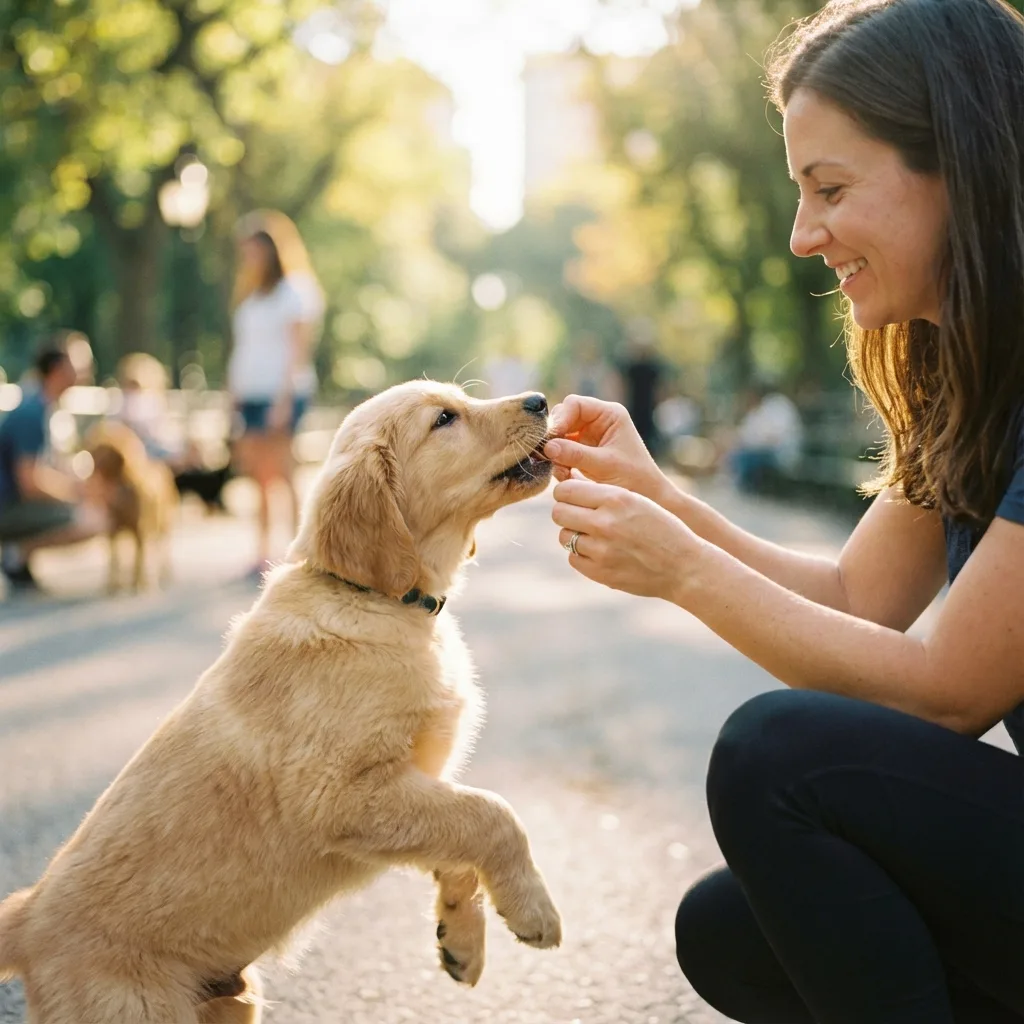
Understanding what your dog is saying
Updated 26 May 2026
According to a British study published in Veterinary Record, more than 80% of dog bites are preceded by warning signals that humans fail to read. Learning to decode canine body language is not just a matter of curiosity: it is a tool for safety, for the animal's wellbeing and for a better owner-dog relationship. Here is a complete guide based on the work of Turid Rugaas, Patricia McConnell and Sophia Yin, world authorities on canine communication.
Why dog language is so subtle
Dogs communicate 90% through their body and 10% through vocalisations. Their repertoire includes more than 30 documented calming signals, dozens of postures and subtle facial micro-expressions. This communication is:
- Constant: your dog is talking every second, even at rest.
- Contextual: the same signal can mean 2-3 different things depending on the situation.
- Holistic: reading one part of the body in isolation (tail, ears) is misleading. You need to read the whole dog.
- Species-specific: dogs "speak dog" to each other, and humans have to learn that language.
Calming signals
Identified and popularised by Norwegian trainer Turid Rugaas in her landmark book On Talking Terms With Dogs, these signals serve to defuse tension, express discomfort or ask for space. The main ones:
- Quick nose licking (not to be confused with wanting food).
- Looking or turning the head away.
- Yawning when not tired.
- Rapid blinking.
- Slow movement (partial freezing).
- Suddenly sitting or lying down.
- Sniffing the ground for no apparent reason.
- Curving the body to approach in an arc.
- Raised paw or pawing.
- Scratching when not itchy.
- Whole-body shake-off after tension.
When your dog shows one of these signals while you are cuddling or talking to them, they are politely asking you for a little space. Respecting this signal builds trust.
The tail: the big misunderstanding
The idea that "wagging tail = happy dog" is one of the most dangerous dog myths. A wagging tail expresses neuro-emotional arousal, which can be positive OR negative. Here is how to read it:
- High, stiff, quivering tail: alert, tension, vigilance — possible escalation towards aggression.
- Very high, plumed tail: confidence, sometimes a defensive or showy posture.
- Low tail wagging fast in small movements: anxiety, submission, stress.
- Low tail tucked between the legs: intense fear, submission.
- Relaxed tail with wide, fluid wags: genuine joy.
- Still tail, held slightly low: neutral observation.
- Asymmetry: scientific research (Quaranta 2007, Current Biology) — dogs wag more to the right for a positive stimulus and more to the left for a negative one.
Reading the eyes and muzzle
The eyes:
- "Whale eye" (a crescent of white showing): fear, stress, a strong early warning of a bite.
- Dilated pupils: high arousal (positive or negative).
- Hard, fixed stare: challenge, alert — never confront it directly.
- Soft, half-closed eyes: relaxed and comfortable.
- Slow blinking: a calming signal.
The muzzle and mouth:
- Relaxed open mouth, loose corners of the lips: a dog at ease.
- Tight closed mouth: tension.
- Lips curled back showing teeth: a clear warning — BACK OFF.
- Wrinkled muzzle: aggression is imminent.
- "Smile" with raised lips and no growl (submissive grin): distinguish it from a snarl — context makes the difference.
Kendal Shepherd's ladder: before the bite
Kendal Shepherd's "Canine Ladder of Aggression" illustrates the gradual escalation before a dog bites. It is extremely rare for a dog to bite "without warning" — it has almost always sent signals the human ignored:
- Level 1 — Nose licking, yawning, looking away.
- Level 2 — Whale eye, ears pinned back.
- Level 3 — Freezing, body stiffening.
- Level 4 — Moving away, lowering the tail.
- Level 5 — Growling.
- Level 6 — Showing teeth.
- Level 7 — Snapping (jaws closing without contact).
- Level 8 — Biting.
The principle: never punish a growl. A dog punished for growling learns to stop warning → it bites straight away. A growl is precious: it is an honest warning.
Whole-body postures
- Neutral, relaxed posture: weight balanced on all 4 legs, supple body, tail at back height.
- Play bow: front end lowered, rear end raised, tail wagging.
- Active submission: lying on the back, belly exposed, possibly urinating. NOT a request for a belly rub — it is an intense calming signal.
- Offensive posture: weight forward, body leaning forward, hackles raised (piloerection), tail up, ears pricked.
- Defensive posture: weight back, ears pinned back, tail between the legs, may show teeth.
Human mistakes to avoid
- Cuddling a dog that is looking away or licking its nose → forcing an interaction it does not want.
- Approaching a dog by leaning over it → a stressful, dominant posture.
- Kissing the dog on the head → a threatening posture for a dog, especially from children.
- Letting a child pick up a dog → most dogs hate it and only tolerate it while sending signals that get ignored.
- Punishing a growl → teaches the dog to bite without warning.
- Staring into the eyes of an unfamiliar dog → a territorial challenge.
- Approaching a dog that is sleeping, eating or has a toy → always give it space.
Learning to observe every day
- Film your dog in different situations (play, meals, walks, meeting another dog). Watch in slow motion.
- Keep a behaviour diary: note the situations where your dog shows calming signals → identify the triggers.
- Teach your children about dog body language (free resources from the French SPA and Lili Chin's Doggie Drawings).
- See a positive-methods trainer at the slightest behavioural doubt.
Keep a behaviour diary
Son Espace Santé lets you record the behaviours you observe and stress triggers every day, and store videos to identify patterns with your trainer or behaviourist. Free, on iOS / Android / web.
Conclusion
Learning to read your dog transforms your relationship. A dog that feels heard, whose signals are respected, becomes calmer, more confident and more cooperative. Conversely, a dog whose warnings are ignored often ends up seeing a behaviourist — or worse, being given up after a bite. Invest time in learning dog body language: it is the best gift you can give your companion.